How to Choose the Best Christian Language Arts Curriculum for Your Homeschool
Just so you know, this post contains affiliate links. That means if you use them to make a purchase, I may earn a commission. You can read my full affiliate disclosure HERE.
Choosing a language arts curriculum for your homeschool can feel pretty overwhelming, right?
When I first started homeschooling, I remember trying to wrap my head around everything that falls under “language arts”: grammar, writing, spelling, vocabulary, literature…yes it’s one subject, but it encompasses an entire collection of skills!
It take me a little time to sort through all of that and figure out what would actually work for our homeschool.
Over the years, I’ve really come to appreciate curriculum that simplifies that process and brings everything together in a clear, manageable way.
But I’ve also learned that it’s not just about finding something that checks all the boxes; it’s also about thinking through what our kids are learning to do with those skills.
Language arts is really about communication. It’s about learning how to think, how to express ideas clearly, and how to engage with what we read and hear. And because of that, the worldview behind a language arts curriculum matters more than we sometimes realize.
Because our kids aren’t JUST learning how to write a paragraph or identify parts of speech. They’re learning how to interpret ideas, how to respond to them, and how to communicate truth. The books they read, the prompts they’re given, and the way they’re taught to think all play a role in shaping that.
That’s one of the reasons that as we’ve homeschooled, I’ve become more intentional about choosing a Christian language arts curriculum—something that doesn’t just sprinkle in Scripture here and there, but actually approaches communication, literature, and writing from a Biblical worldview.
So, I’m going to walk you through a few things to consider as you choose a language arts curriculum, and then share some of (in my humble opinion!) the best Christian language arts curriculum options for homeschoolers…including one that I’ll be using with my own kids next year!
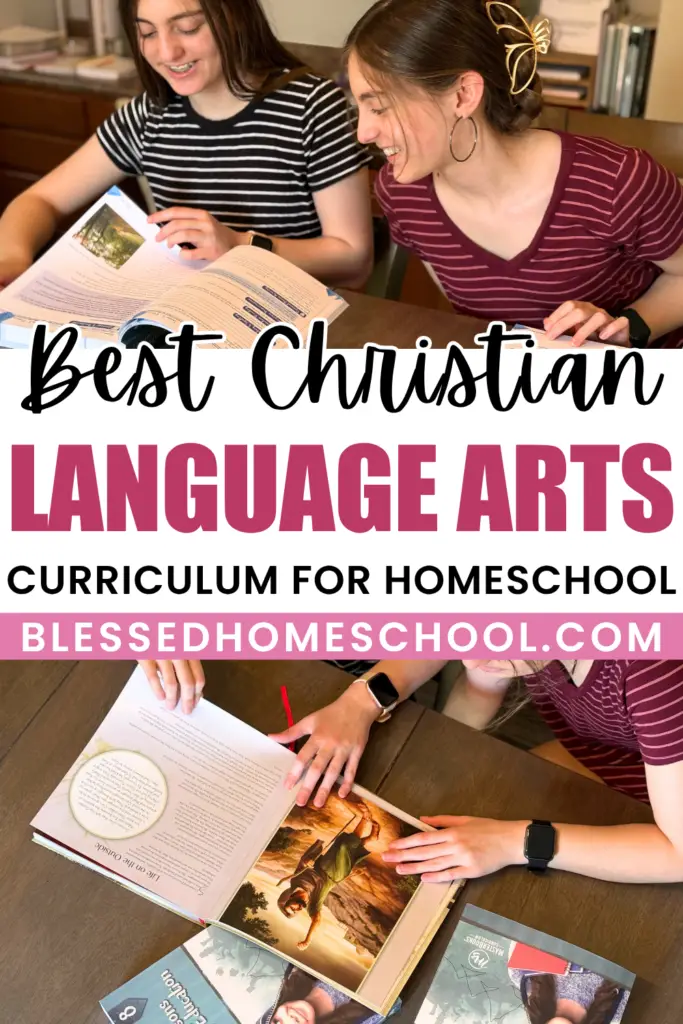
How to Choose a Homeschool Language Arts Curriculum
Before jumping into specific recommendations, it’s worth taking a little time to think through what your child actually needs in a language arts program. Not every curriculum approaches this subject the same way, and the “best” option really depends on your child and your homeschool.
Here are a few things I recommend considering when choosing language arts:
1. Writing Ability vs. Reading Level
Many language arts programs are built around reading level, but writing can be the area where students need more support. It’s not uncommon for a child to be reading well above grade level, but still struggle when it comes to organizing their thoughts, writing clearly, or completing longer assignments. It can be really frustrating for kids to use a curriculum where a strong writing ability is assumed, but they’re not quite ready.
So don’t forget to take this into consideration when you’re making your decision. Choosing a language arts curriculum that meets them where they are in writing (and not just reading!) can make a big difference in both their confidence and progress.
2. Integration vs. Separate Subjects
Language arts can be taught in a variety of ways; some families prefer separate programs for grammar, writing, spelling, literature, and vocabulary, while others prefer an integrated approach where everything is combined. We’ve enjoyed both options in different seasons!
An integrated curriculum can simplify your day by bringing all of those components together into one plan. It often helps students see how the pieces connect, rather than treating each one as a completely separate subject.
At the same time, some students benefit from focusing on one skill at a time, especially if they need extra support in a specific area like writing or grammar.
There isn’t one right answer here—it really comes down to what works best for your family and how your child learns.
3. Biblical Worldview
Some language arts programs include Scripture (or Christian values and Biblical themes) occasionally, while others intentionally weave a Biblical worldview throughout the lessons, showing up in the reading selections, writing prompts, discussion questions, and overall approach to communication and truth. I think either option can be great, but it’s helpful to understand that difference so you can choose what best fits your goals for your child.
4. Independence and Parent Involvement
Another important consideration is how much involvement the curriculum requires from you as the parent. Some are very parent-led and require regular teaching, discussion, or grading, while others are more open-and-go, or designed so students can complete much of the work independently once they understand the structure.
I think this often becomes a bigger factor as your kids get older. A curriculum that supports independent learning can free you up to work with other children or manage the rest of your homeschool day.
At the same time, some parents may prefer to stay closely involved, especially in areas like writing and literature discussions. So, thinking through how this fits into your daily routine can help you choose something that is sustainable long-term.
Taking the time to think through these areas can make choosing a language arts curriculum feel much more manageable, and help you find something that truly fits your child and your homeschool.
⭐ Top Pick: Master Books Language Lessons for a Living Education (LLFLE)
If you’re looking for a Christian language arts curriculum that brings everything together in a clear and manageable way, Master Books is the one I’m most excited about right now.
We’ll be using Language Lessons for a Living Education Level 8 for my twin girls and LLFLE Level 2 for my youngest next year, and after spending time going through the curriculum, I can see why so many families love it!
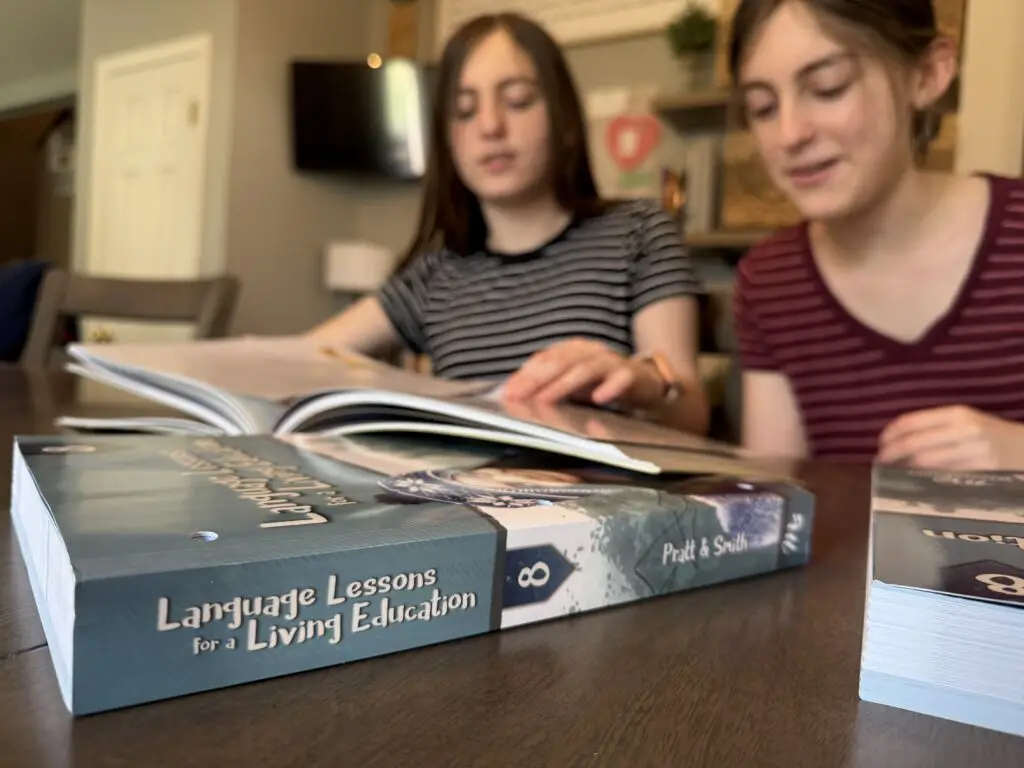
One of the biggest things that stood out to me is how everything is combined into one book—grammar, spelling, writing, vocabulary, communication—all working together instead of feeling like separate subjects. That alone is going to simplify things for us in a season where we need it!
But what really sets Language Lessons for a Living Education apart is the structure (I just love this about the curriculum!).
Each week follows a consistent rhythm, and each day has a specific focus. Students know what to expect as they move through the week, with time spent on vocabulary and Scripture, grammar and punctuation, writing and communication, worldview, and then a review at the end of the week. Writing, in particular, is handled very intentionally, with students being guided through the process rather than simply being assigned papers.
Another thing I appreciate is the emphasis on writing ability and stamina rather than just reading level. I mentioned above that this is not something you see in most language arts programs, but it makes a lot of sense!
Finally, if you’ve ever heard or wondered whether Master Books is “too easy,” I would really encourage you to read more about their GENTLE Approach™, which focuses on short, developmentally appropriate lessons that build skills over time, while protecting confidence and enjoyment. Their goal isn’t to reduce rigor…rather, they aim to make learning more effective by aligning it with how students actually grow and develop. I really appreciate this!
Personally, I love that I don’t have to choose between strong academics and a Biblical worldview. This curriculum does both in a way that feels natural and consistent, and I’m really looking forward to using it next year!
Other Christian Language Arts Curriculum Options
BJU Press Language Arts
BJU Press is a well-known option for families who prefer a more traditional, structured approach to language arts. In the younger years, you’ll find separate books and lessons for subjects like English, Handwriting, Spelling, and Reading; Writing and Literature are combined for older grades.
I think one of the strengths of BJU Press is their commitment to a Biblical worldview education. Lessons are comprehensive and build on each other, and there’s a strong emphasis on grammar and writing skills. Many families also appreciate the option to use their online video lessons, which can be especially helpful as students get older and begin working more independently (or if you’re in the middle of a busy season and need some extra help teaching!).
This can be a great fit if you’re looking for an academically solid program with clear expectations and built-in accountability. It does tend to feel more “school-like,” which works really well for some students and families.
Generations Language Arts
Generations offers a Christ-centered approach to language arts that places a strong emphasis on Biblical worldview, character, and family discipleship. In using some of their curriculum, I’ve appreciated that they incorporate Scripture, feature classic literature, and promote meaningful discussions that go beyond academics.
One thing that stands out with Generations is their focus on raising thoughtful, articulate Christians who can engage with the world from a strong foundation of truth. Writing, reading, and analysis are all tied back to a Biblical perspective in a very intentional way.
This can be a great fit for families who want language arts to feel deeply connected to their faith and who value rich conversations and worldview development alongside skill-building.
Sonlight Language Arts
Sonlight takes a literature-based approach to language arts, combining reading, grammar, writing, and discussion through carefully selected books. Rather than relying heavily on textbooks, students learn through exposure to high-quality literature and guided conversation.
This approach works especially well for families who enjoy reading together and want language arts to feel more relational and discussion-based. Writing assignments are included, and they are often tied directly to what students are reading.
Because Sonlight is built around book-based learning, it can require more parent involvement, especially in the younger years. However, lots of families love the depth of understanding and connection that comes from learning this way.
Christian Light Education (CLE) Language Arts
Christian Light Education offers a workbook-based language arts program that focuses on consistent practice and mastery. The curriculum is broken into smaller worktexts, which can make it feel very manageable for kids to use, rather than a thick textbook!
CLE places a strong emphasis on grammar, spelling, and writing, with regular review built into the lessons. The structure is straightforward and predictable, great for kids who thrive with a routine.
This can be a great option for families who prefer a no-frills, easy-to-follow approach with steady reinforcement of foundational skills. It also works well for independent learners who do well with clear instructions and daily practice.
Abeka Language Arts
Abeka is another very traditional, structured language arts curriculum that has been used by homeschool families for many years. It places a strong emphasis on phonics (in the early years), grammar, spelling, and writing, with consistent review built into the lessons.
One of the biggest strengths of Abeka is how thorough it is. Students get a lot of practice, especially in grammar and mechanics, and concepts are reinforced regularly. The curriculum follows a clear scope and sequence, so it’s easy to see what your kids are learning and how skills are building over time.
Like BJU Press, Abeka also offers video instruction, which can be helpful if you want more support or a classroom-style experience at home.
Learning Language Arts Through Literature (LLATL)
Learning Language Arts Through Literature (LLATL) takes a more literature-based approach, integrating reading with language arts skills like grammar, writing, and vocabulary. It is written from a Christian perspective, but the focus is more on the literature and skill development than on direct worldview instruction within the lessons.
Instead of separating each component of language arts, lessons are often built around the books students are reading, with activities that encourage discussion, comprehension, and written responses. This can create a more natural, connected learning experience, especially for families who enjoy reading together.
This type of approach can be a good fit for students who love books and prefer a more relaxed, discussion-based style of learning. It’s much more flexible and can feel less rigid than more traditional programs.
At the same time, because it is less structured in some areas (particularly writing), it may not be the best fit for every student. Some kids will benefit from more direct, step-by-step instruction when it comes to developing writing skills, especially as they get older.

📊 Christian Language Arts Curriculum Comparison
If you’re trying to narrow things down, here’s a quick comparison to help you see how these programs differ at a glance:
| Curriculum | Approach | Best For | Strengths | Prep Level |
|---|
| Master Books Language Lessons for a Living Education (LLFLE) | Integrated (all-in-one) | Families wanting a complete, structured program with strong writing development | Combines grammar, writing, vocabulary, and communication in one book; clear daily structure; strong Biblical worldview; builds writing skills step-by-step | Low |
| BJU Press Language Arts | Traditional, structured | Families who prefer a textbook-style curriculum with clear expectations | Strong grammar and writing instruction; structured lessons; optional video teaching; academically thorough | Medium |
| Generations Language Arts | Biblical worldview + literature-based | Families prioritizing discipleship and worldview integration | Deep Biblical integration; focus on character and communication; meaningful reading and writing connections | Medium |
| Sonlight Language Arts | Literature-based | Families who love reading together and discussion-based learning | High-quality book selections; strong comprehension and discussion; relational learning style | High |
| Christian Light Education (CLE) | Workbook-based | Independent learners who thrive with routine | Simple, predictable structure; strong grammar and spelling practice; easy to follow | Low |
| Abeka Language Arts | Traditional, phonics & grammar-focused | Families wanting a rigorous, school-style approach | Thorough grammar and phonics; consistent review; structured scope and sequence; optional video instruction | Medium |
| Learning Language Arts Through Literature (LLATL) | Literature-based, integrated | Families who prefer a gentle, reading-centered approach | Integrates reading with writing and grammar; flexible and discussion-based; less rigid structure | Low–Medium |
As you can see, each of these takes a slightly different approach to language arts, which is why it’s so important to think about what will work best for your child and your homeschool.
Final Thoughts
There’s no single “perfect” language arts curriculum for every homeschool. The best choice will depend on your child’s strengths, areas of growth, and how your homeschool operates day to day. What works beautifully for one family may not be the right fit for another.
As you’re choosing, focus on what will serve your child well right now and what you can realistically use in your homeschool. Consistency over time matters far more than finding something that checks every possible box!
And whatever you choose, the goal is the same—to help your child grow into a confident communicator who can think clearly, write well, and engage with the world from a strong foundation of truth. If you’re in the middle of planning right now, I hope this gives you a helpful place to start!