Math That Actually Matters: Why I Love Master Books’ Consumer Math
Just so you know, this post contains affiliate links. That means if you use them to make a purchase, I may earn a commission. You can read my full affiliate disclosure HERE.
When it comes to teaching high school math, many homeschool moms (myself included!) want something that goes beyond just formulas and worksheets. We want our teens to be ready for the real world—especially when it comes to handling money wisely.
You know, we want to teach our kids all of the things that WE didn’t learn in school.
Personal finance courses are a great option, and many states actually now require personal finance for high school graduation. But there’s another option that many parents don’t know about that I think is just as valuable…and that’s consumer math.

In this post, I’m going to be sharing a full review of a BRAND NEW consumer math curriculum from Master Books that I think you’re going to want to add to your high school curriculum line-up. I’m also going to answer an important qustion:
What’s the difference between Consumer Math and Personal Finance—and does your student need both?
📊 Master Books Consumer Math: At a Glance
- Course Title: Consumer Math: Biblical Stewardship & Personal Finance
- Recommended Grades: 9th–12th
- Credit: 1 full high school math credit
- Length: Full-year course (180-day schedule)
- Lesson Time: ~45 minutes/day, 5 days/week
- Format: Printed Student Text + Teacher Guide (online course available through Master Books Academy)
- Biblical Integration: Yes – Scripture-based financial principles woven throughout
- Topics Covered: Budgeting, taxes, saving, giving, debt, insurance, housing, investing, retirement, career planning & more
- Best For:
✅ Teens preparing for real-world financial decisions
✅ Students not pursuing upper-level math OR
✅ Elective option for STEM or college-bound students
Consumer Math vs. Personal Finance: What’s the Difference?
These two terms get used interchangeably sometimes, but they’re actually pretty different—and knowing the difference can help you choose the best fit for your high schooler.
👉 Personal Finance
Personal finance courses are all about developing healthy money habits and financial literacy. They usually include topics like budgeting, saving, credit and debt, insurance, taxes, college planning, and more. Courses like Foundations in Personal Finance by Dave Ramsey are great examples. These are often video-based and designed to be completed in one semester for elective or economics credit.
👉 Consumer Math
Consumer Math, on the other hand, is a full-year math course that counts as one high school math credit. It covers many of the same financial topics, but with an added focus on math application. So, students aren’t just learning what a mortgage is—they’re calculating the payments. They practice real-world math skills like:
- Interest and percentages
- Budgeting calculations
- Tax estimation
- Cost comparisons
- Financial decision-making
Consumer Math is often recommended for students who aren’t headed down the advanced math track but still need useful, real-life math that builds confidence and critical thinking. However…
➡️ Many homeschool families choose to do both—using Personal Finance as a one-semester elective and Consumer Math as a full-year course for math credit.
When Should Your Teen Take Consumer Math?
A consumer math class is recommended for grades 9 through 12, and the best timing depends on your teen’s readiness and goals.
✅ Why You Might Choose 9th or 10th Grade:
- Your teen is getting a job or a driver’s license
- They’re earning and spending their own money
- You want to lay a foundation for stewardship early
✅ Why You Might Choose 11th or 12th Grade:
- They’re making bigger financial decisions (college, career, car loans, etc.)
- They need one more high school math credit
- They’ll understand more complex topics like retirement and investing better
For many families, 10th or 11th grade is the sweet spot—early enough to apply what they’re learning, but mature enough to grasp deeper concepts.
And yes—even STEM students can benefit from a consumer math course! While they’ll still need to complete upper-level math for college prep, consumer math can be a fantastic elective to teach the practical side of financial stewardship.
What’s Included in the Master Books Consumer Math Course?
Consumer Math: Biblical Stewardship & Personal Finance is a course I can’t wait for my own kids to take someday.
The curriculum set comes with:
- A full-color Student Text that’s packed with case studies, real-life applications, Scripture-based insights, and step-by-step explanations.
- A Teacher Guide that includes a 180-day schedule, daily assignments, and answer keys.

Optional video instruction is also available through Master Books Academy, which is a great resource for visual learners 🙌.
The curriculum is designed to be completed 5 days per week in about 45 minutes per lesson, over the course of a full school year. Your child will earn one high school math credit after successful completion.
What Topics Are Covered in Consumer Math?
This course is broken down into four quarters:
📆 Quarter 1:
- Giving
- Living expenses
- Debt
- Taxes
💰 Quarter 2:
- Budgeting basics
- Medical expenses
- Planning for big purchases
🚗 Quarter 3:
- Buying a car
- Career planning
- Housing decisions
📈 Quarter 4:
- Investing and retirement
- Business math
- Final review
So in my opinion, it’s very comprehensive! By the end, students will know how to create and manage a personal budget, understand checking and savings accounts, and make sense of credit, debt, interest, and investment strategies.
They’ll also learn how to navigate major financial decisions—like renting or buying a home, choosing insurance coverage, and planning for big expenses.
But more than all of that, this course builds discernment—helping students make wise financial choices grounded in Scripture and a biblical view of stewardship.
My First Impressions
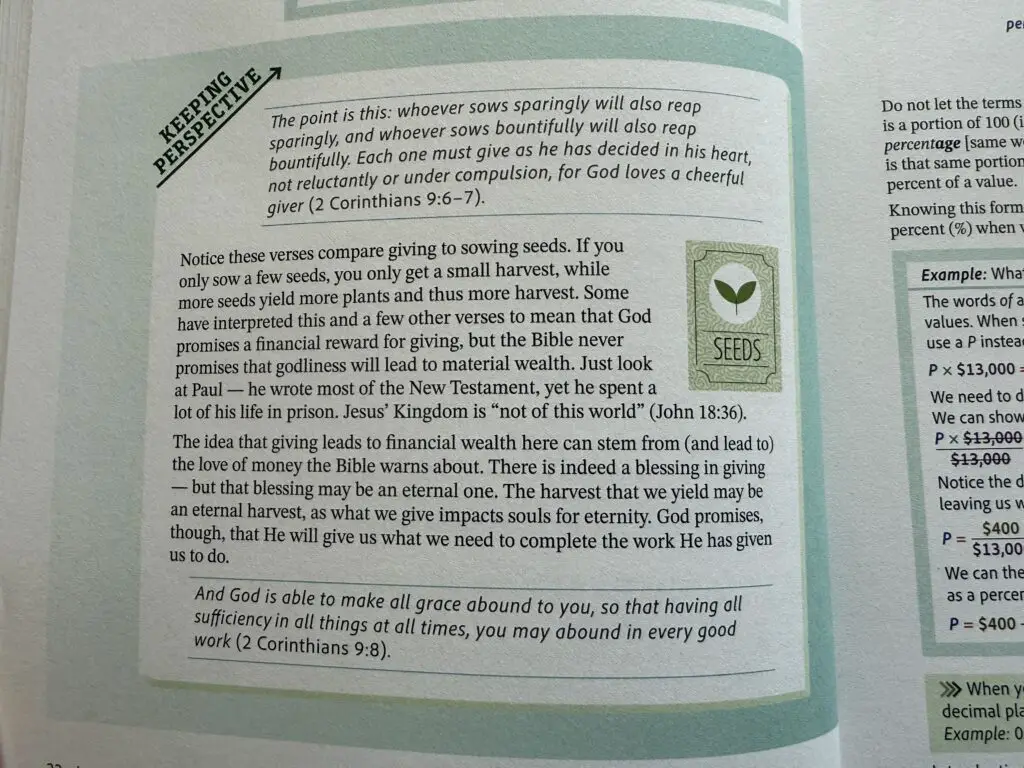
When I first flipped through the Student Text, I was immediately impressed. The layout is clean and colorful without being distracting, and the real-life scenarios are so relatable—everything from renting an apartment to choosing a savings account.
I also appreciated that the biblical integration wasn’t just an occasional verse—it’s thoughtfully woven throughout the lessons. Your teen will not only be learning math, but will also be discipled in financial wisdom.
I can already see how this is going to be one of those “real life” courses that sticks with my kids long after graduation.
Flip-through of Consumer Math Curriculum 📽️
As with all Master Books courses, they make planning really easy with a suggested daily schedule. Everything is laid out and tells you what lessons and exercises to do each day, and gives you a space to write in a due date, check off the assignments and record grades.
Here’s a full flip-through and review so you can see inside the books a bit better, and all of the different features included in the lessons. There’s so much thought put into the curriculum that makes it super user-friendly for both students and parents!
Consumer Math Lesson Highlights
This course is very student-driven, which I love. Your teen can work through it independently if you choose to, since all the explanations are written directly in the student text—complete with real-world examples and biblical connections throughout.
A Peek at the Textbook
In each of the lessons, key terms are bolded and highlighted, and definitions and explanations are provided right in the lessons to help students understand the concepts better.
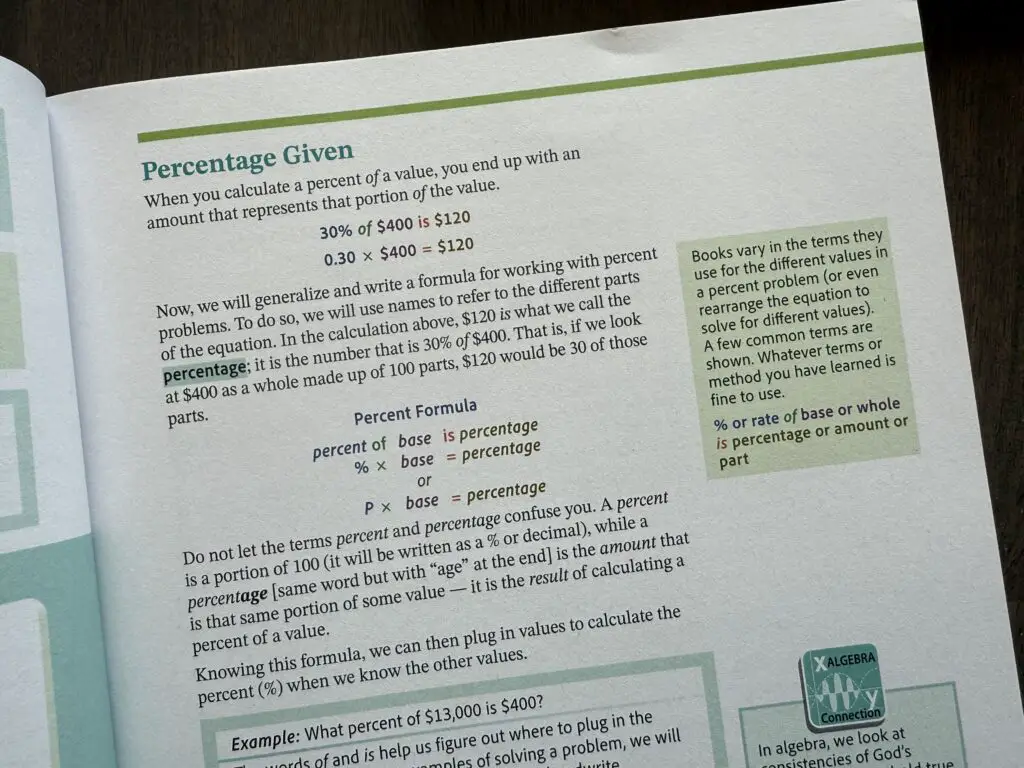
You’ll also see these little arrow symbols throughout the text, which are used to highlight important rules or steps in solving problems:
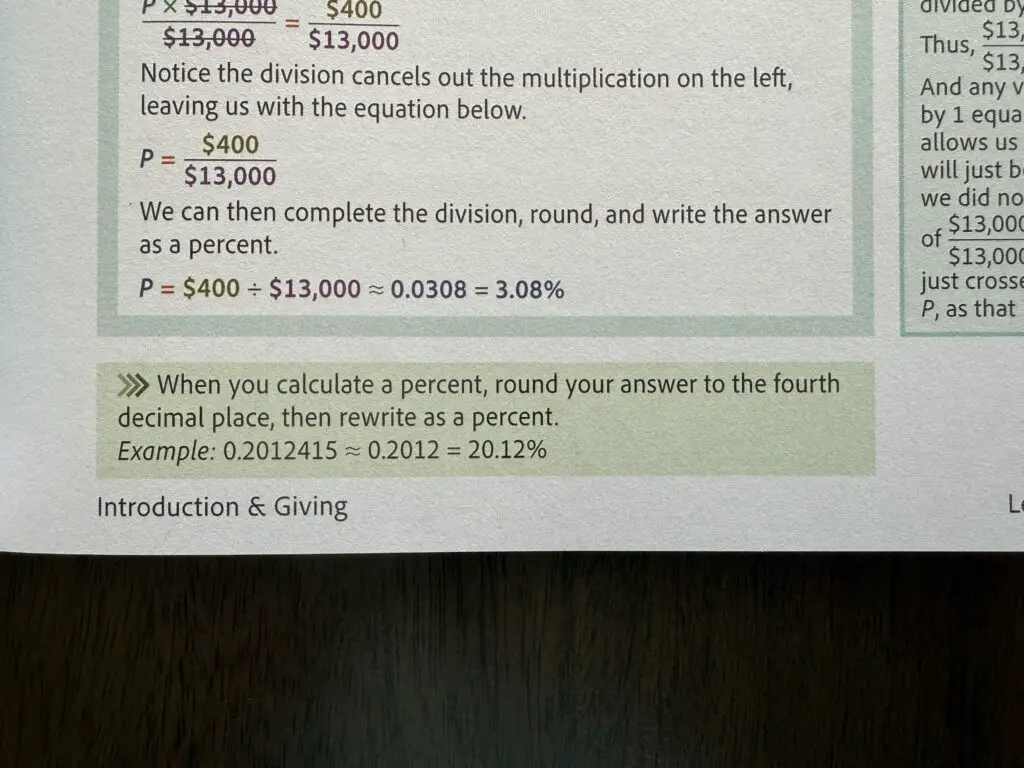
You’ll also find case studies scattered throughout the book—these are short, real-life stories that help bring the math concepts to life by showing how they connect to practical decisions and biblical principles.
And finally, I LOVE that they include mental math practice to sharpen quick calculation skills (of course, if your student needs to work problems out on paper, that’s totally fine! But there are so many really helpful mental math reminders throughout the lessons, which is very applicable to and helpful in real life).

Each lesson includes a little summary and review, so your student is continually reminded of what they’ve already learned. And on many of the lesson pages, Biblical principles and application are being reinforced; so, even if YOU didn’t learn math through a Biblical worldview, this curriculum WILL help you teach your kids to view their money and finances through the lens of Scripture.
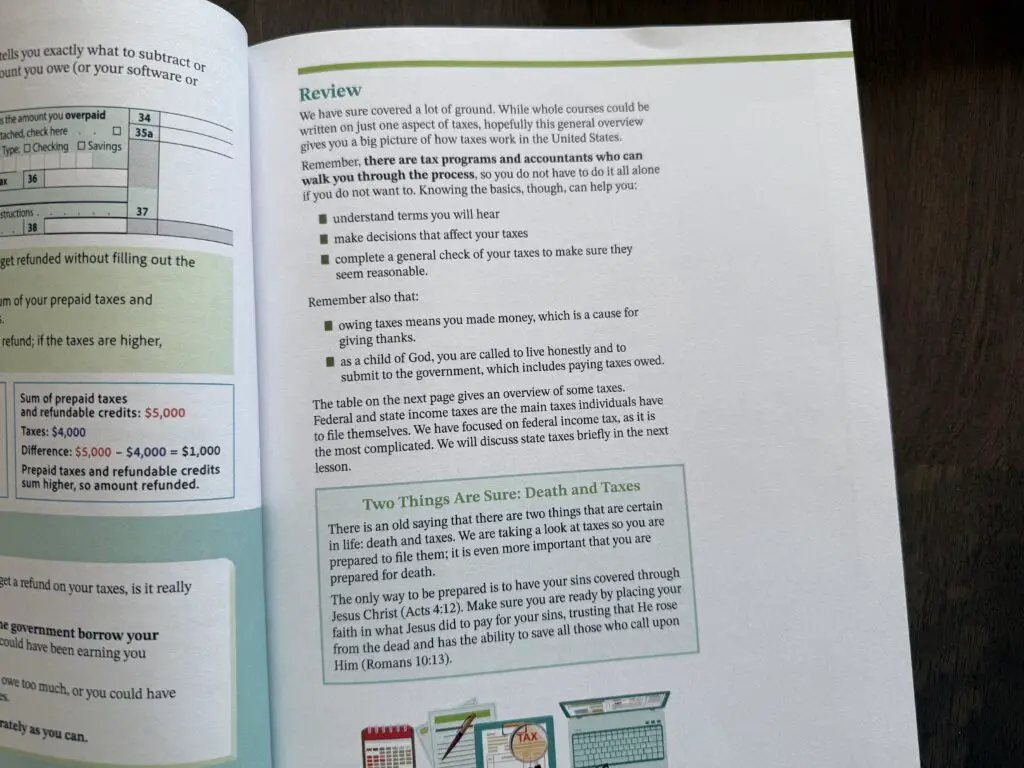
Teacher Guide + Worksheets
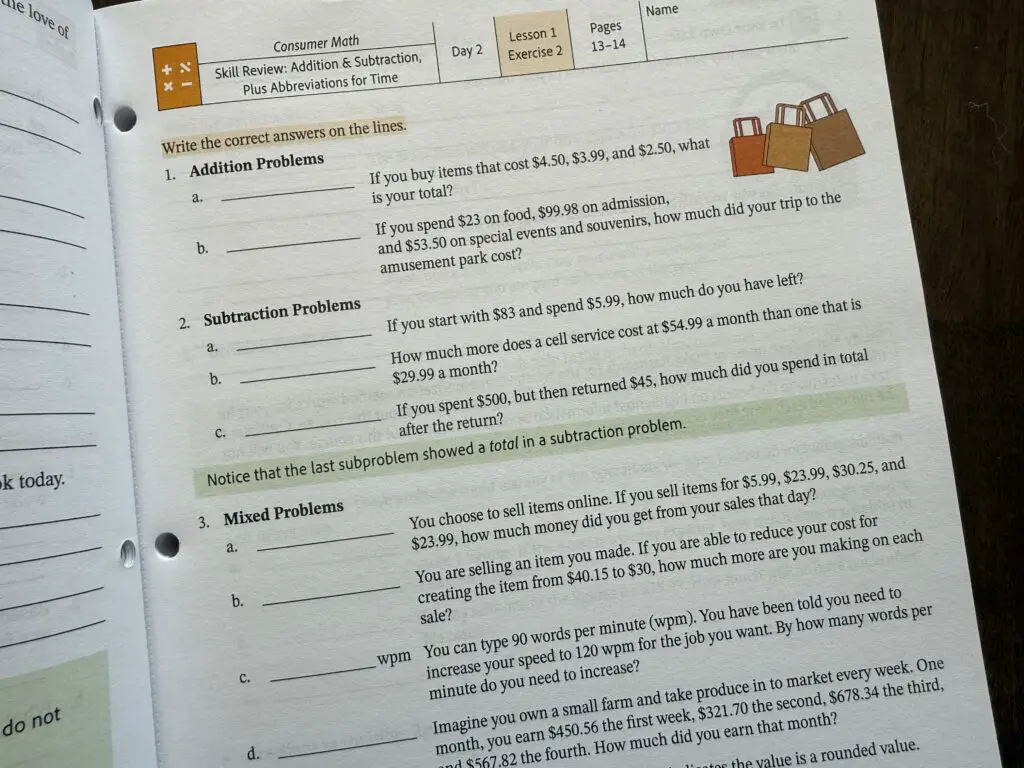
Each lesson has a worksheet to go with it so that students can do the math and put what they’re learning into practice (these are included in the Teacher Guide).
There are typically 2 pages in the textbook students will read each day, and then do a corresponding worksheet. So it’s very manageable, and the worksheets have a lot of different components that make the assignments interesting!
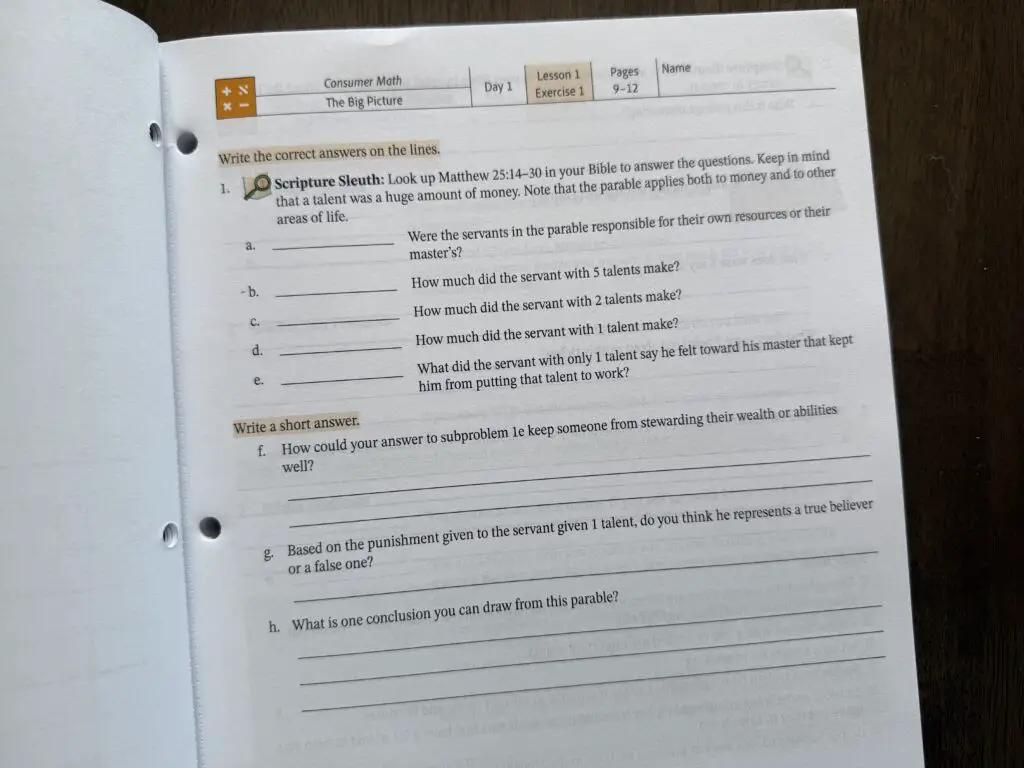
There’s a fun addition to the worksheets called Scripture Sleuth activities. These encourage students to look up verses on their own, and really think about how God’s Word applies to financial topics. It’s a great way to keep them grounded in biblical truth while they’re learning money skills!
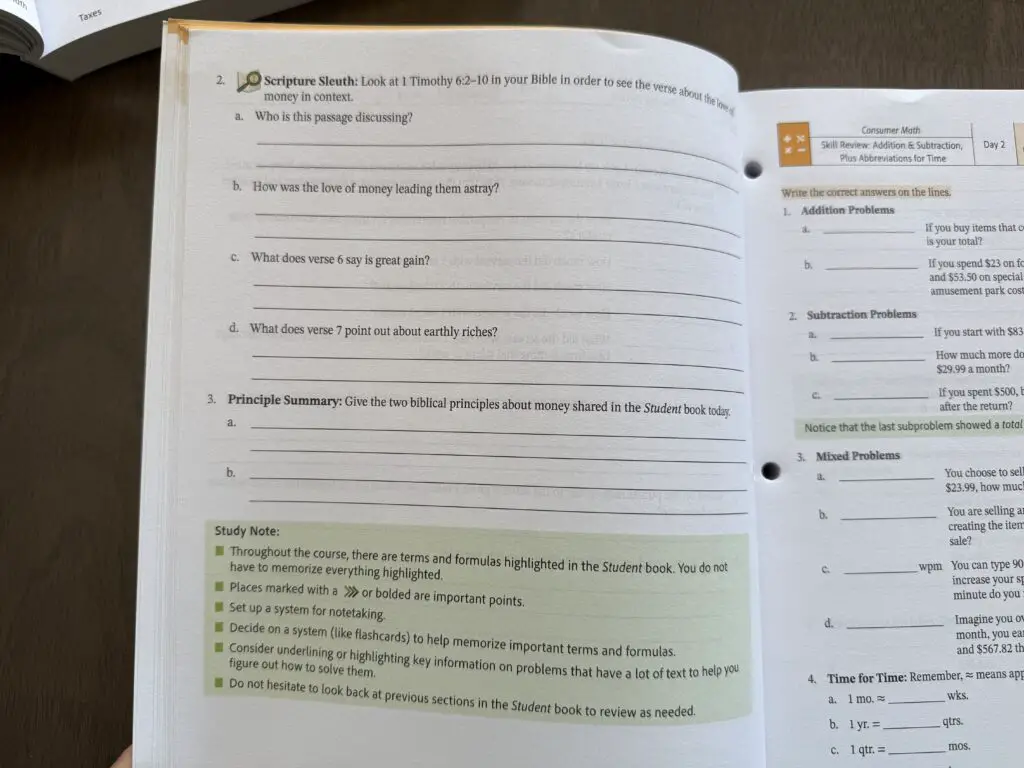
Occasionally you’ll see little green boxes on the worksheets; these offer study notes, or even little helpful hints and reminders.
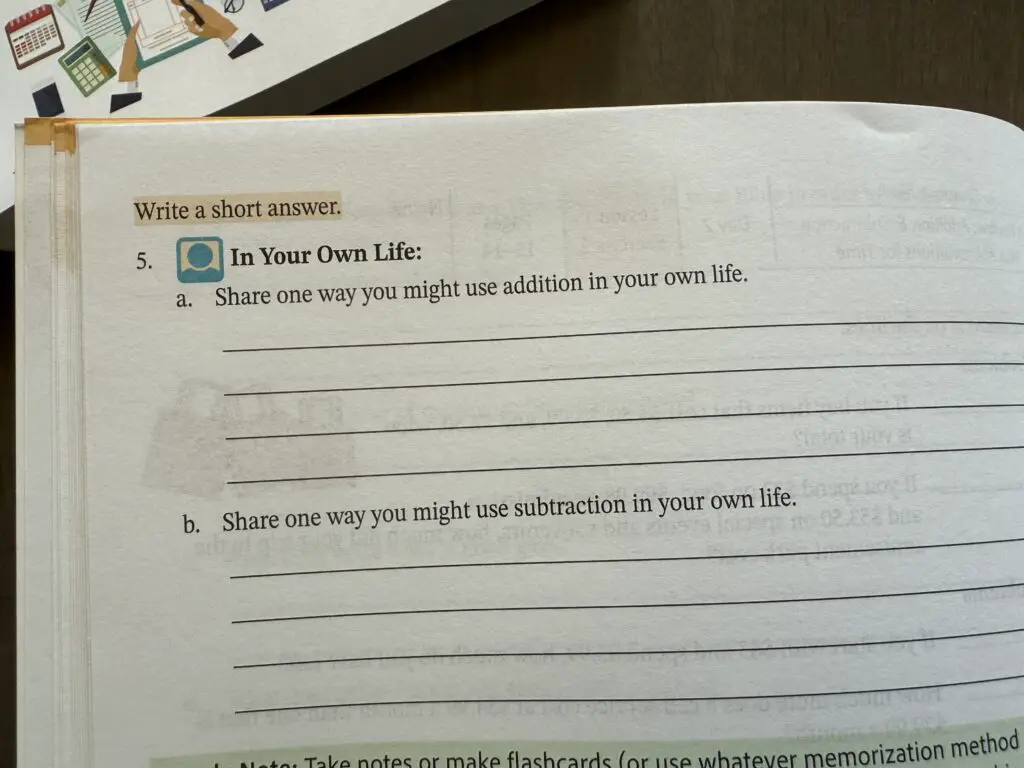
“In Your Own Life” application questions give students the chance to apply what they’re learning to their personal circumstances. This is the kind of thing that really helps the material stick, so I love that this is included.
For students who like a little extra challenge or practice, there are optional application activities included, some of which require a computer or internet. Those are marked clearly with a little globe icon and a note to get parent permission.
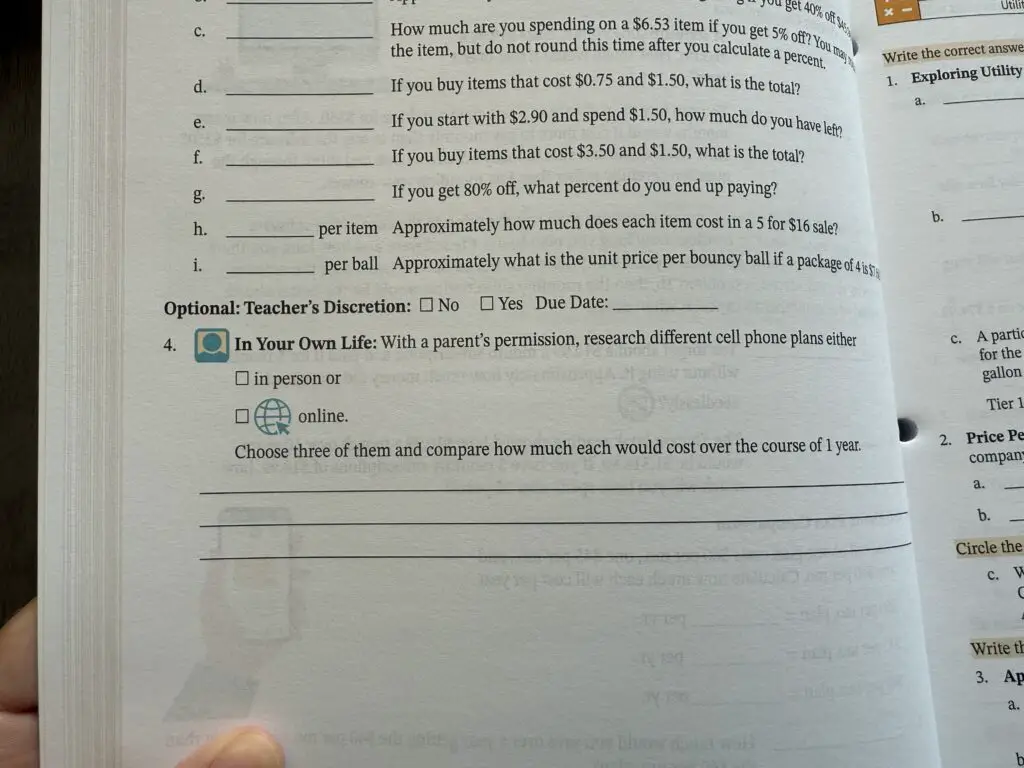
From a math skills perspective, throughout the course students are practicing all kinds of useful calculations: budgeting, interest, comparing loan options, estimating taxes, even planning for retirement. It’s math that is going to matter to them in their day-to-day lives for the rest of their lives, which makes this course so valuable.
What Makes It Unique?
Here’s what I love most about Consumer Math from Master Books (and why I recommend it!):
- ✝️ Biblical Integration: Through Scripture Sleuth activities and faith-based case studies, students learn to view money and decision-making through the lens of God’s Word.
- 🧠 Real-World Math: Teenagers get to apply practical skills to real-life scenarios—rent, insurance, taxes, savings, investing, and more.
- 📒 Easy to Teach: The included Teacher Guide and daily schedule make it simple to stay on track without extra prep (#timesaver).
- 📚 Engaging Format: Full-color pages, thoughtful questions, and meaningful application make this course feel relevant and personal—not just another textbook.
📊 Homeschool Consumer Math Curriculum Comparison
I was curious to know how Master Books Consumer Math stacked up against some of the other options out there. Here’s what I found:
| Feature | MasterBooks Consumer Math | Not Consumed – Consumer Math for Real Life | Alpha Omega – LIFEPAC Consumer Math | Easy Peasy Consumer Math (free) |
| Grade Levels | 9–12 (flexible timing) | 11–12 | 11–12 | 9–12 |
| Credit Value | Full-year, 1 math credit | Full-year, 1 math credit | Full-year workbook series, 1 credit | Full-year, 1 credit (free) |
| Biblical Integration | ✅ Biblical wisdom woven throughout | ✅ Biblical wisdom woven throughout | ✅ Christian worldview included | ❌ Secular/unaffiliated |
| Format | Printed Student Text + Teacher Guide; video lessons available | Text-based + parent guidance, project-based | Consumable worktexts + Teacher’s Guide | Online texts, links, self-paced |
| Instructional Style | Daily lessons (~45 min), open-and-go, schedule included | Project-based, open-ended, more autonomy | Mastery-based self-paced worksheets | Self-paced online reading with external links |
| Assessments | Worksheets, daily application, end-of-unit review | 22 real-world projects, complex rubrics | Self-tests, unit tests with answer keys | Online quizzes and optional activities |
| Price (approx.) | ~$97.98 (complete set) | ~$49 | ~$89.50 box set | Free |
| Ideal For | Homeschool moms seeking structured, faith-integrated, real-world math | Teens ready for independent, project-based learning | Parents wanting mastery workbooks and Christian continuity | Families with minimal budget or seeking a supplemental option |
Which Consumer Math Curriculum Is Right for Your Teen?
As you can see, there are several great options out there for homeschool Consumer Math—but they each serve slightly different needs.
If you’re looking for a structured, easy-to-teach course with strong biblical integration, Master Books Consumer Math stands out. It’s ideal for families who want open-and-go lessons, real-life application with biblical depth, and Christ-centered financial teaching that builds both math confidence and spiritual wisdom.
Frequently Asked Questions about MasterBooks Consumer Math
What grade level is this course for?
The Master Books Consumer Math course is recommended for grades 9–12. It’s flexible enough to be used anytime during high school though, depending on your teen’s readiness and math plan.
Can this course replace Algebra 2 or Pre-Calculus?
For students who are not pursuing a STEM major or higher-level math in college, yes—it can often count as their final high school math credit. Be sure to check your state’s graduation requirements to confirm, though. For students on a college-prep or STEM track, it’s best used as a valuable elective alongside traditional math courses.
How many credits is it worth?
The course is designed as a one-year high school math course and is worth 1 math credit on a homeschool transcript.
Is this the same as a personal finance course?
Not quite. While it covers topics like budgeting, debt, and saving, Consumer Math goes deeper into the actual math applications—things like calculating interest, estimating taxes, and comparing costs. It’s more hands-on and math-focused than most personal finance electives. Many families choose to do both, using personal finance as a one-semester elective and Consumer Math as a full-year math course.
Does the course include biblical teaching?
Yes! This course is intentionally written from a biblical worldview. Your teen will explore what God’s Word says about stewardship, generosity, contentment, and wise financial decisions through Scripture Sleuth activities and real-life case studies.
How much daily work is required?
The course follows a 180-day schedule, with lessons planned for about 45 minutes per day, five days a week. It’s designed to be open-and-go for homeschool families.
Is there video instruction available?
Yes—optional video instruction is coming soon through Master Books Academy, which will be a great bonus for students who enjoy audio-visual learning or need extra explanation.
Can I use this with more than one student?
Yes, but you’ll want a consumable Teacher Guide book for each student.
Is this course enough to prepare my teen for real life?
Absolutely. This course doesn’t just teach your teen how to work with numbers—it equips them to make wise financial decisions, understand real-world math, and view their money through the lens of biblical stewardship. It’s one of those courses that truly prepares them for life after graduation.

Final Thoughts
Master Books Consumer Math course is practical, biblical, and easy to use. It gives your teen the tools they need to manage money well—and the wisdom to do it for God’s glory. It will truly be an investment in their future!
Have questions about Consumer Math or how to fit it into your homeschool plan? Drop a comment below—I’d love to help!
Giveaway: Win Consumer Math Curriculum!
🎉 Exciting news! Master Books is generously giving away a copy of this Consumer Math curriculum—and I’m thrilled to share it with you!
If this sounds like something your homeschool could use, be sure to check out the giveaway details below and enter for a chance to win.

Blessed Homeschool is a participant in the Amazon Services LLC Associates Program, an affiliate advertising program designed to provide a means for sites to earn advertising fees by advertising and linking to Amazon.com. You can read my full affiliate disclosure HERE.