5 Ways To Confidently Teach Literacy Skills At Home
Just so you know, this post contains affiliate links. That means if you use them to make a purchase, I may earn a commission. You can read my full affiliate disclosure HERE.
Parents play a vital role in the early development of our kids’ literacy skills. Learn specific strategies you can implement in your homeschooling today to lay a solid foundation for reading!
Homeschool parents are their children’s biggest supporters, and that goes for learning how to read and write as well!
We know how important it is for our children to be literate, and we hope to develop a love of reading and writing along the way. The good news is that setting young children up for success doesn’t always mean sitting them down with workbooks, tedious lessons, or drilling handwriting practice.
Homeschoolers know better than anyone that kids learn best through authentic learning experiences, and ideally, through multisensory learning opportunities. There are so many ways to lay a solid foundation in early literacy skills right from the start!


Why Build Literacy Skills At Home
Reading is a skill that can be developed and improved through practice and exposure. Literacy skills are essential for children to learn, grow and succeed in life.
Parents play a vital role in supporting their children’s early literacy development. Young readers learn to read by being read to, hearing stories, and having conversations with others about what they hear or read.
There are also specific skills we can teach our kids in the home environment that will support them in becoming readers. The more opportunities a child has to practice and engage with reading activities, the better they will get at it!
Which Foundational Skills To Focus On
If you’re wondering which literacy skills to focus on, look no further than the five pillars of early literacy.
These five pillars make up the basics of reading and are best taught in a connected manner. By weaving these skills together, you reduce learning gaps and help kids make ever-important connections.
The 5 Pillars of Early Literacy
Phonemic Awareness
Phonemic awareness is a subset of phonological awareness, which encompasses skills that are important for early reading success. Phonemic awareness specifically is the ability to identify individual sounds in the English language, and then to manipulate them to form words.
Phonics
Recognizing the connections between how words sound, and how they look when written on paper. Intentional phonics instruction can be a big benefit in the early years of learning to read and spell new words.
Vocabulary
The entire collection of words that a person recognizes, understands, and can use in everyday language. This includes oral vocabulary along with reading vocabulary.
Fluency
The ability to look at a text and recognize the words without stopping and figuring out the pronunciation.
Comprehension
Being able to look at a text and understand what the author meant. This is heavily influenced by a child’s personal experiences, background knowledge, exposure to the language being used, and ability to connect text and everyday life in a meaningful way.
You may be thinking, “This all makes sense, but how do I put this into practice in our homeschool?” Here are some practical ways these building blocks can be easily added to your homeschooling.
5 Ways To Build Literacy Skills At Home
Method 1: Read Together
Read together with your child, which helps in developing pre-literacy skills like print awareness. Read aloud to your child every day until they can read independently on their own. Incorporate motions for the sounds you are focusing on, and invite your child for hunt for the sounds as you read by performing the motion when they hear the sound.
Choose reading materials that interest your child. If your child seems bored by a book or does not want you to finish reading it aloud, then choose another book instead. You should keep looking until you find one that interests both of you enough so that you both want to continue reading it together over and over again!
The goal is to develop a love of reading and print motivation, and the environment should always be positive and low-pressure. By letting them lead the way with choice, they are more likely to feel like reading is fun!
Method 2: Talk about what you read
Talk about what’s happening in the story as you go along. Ask questions like “Why do you think that happened?” or “What do you think will happen next?” so your child gets involved in the story and thinks about what’s happening.
Ask your child questions about the story after it’s over, too — like why did that character feel that way? Ask open-ended questions (questions that don’t have yes or no answers), so your child has to put some thought into her answer and explain why she thinks something is true or false instead of just saying yes or no without explaining anything at all. This helps build critical thinking skills as well as reading comprehension skills!
Method 3: Let Them Tell Stories — And Then Write Them!
A fun way to practice writing is by getting your kids to write their own stories. This is a great way to encourage creativity and imagination while also giving them practice correctly forming letters of the alphabet. Handwriting stories help to teach them how to write letters, and to also learn how sounds and letters relate.
You can even have your child draw a picture of what happens in each chapter, enhancing their ability to visualize what they are writing about.
If your kid is too young to write letters, they are still building important literacy skills by drawing pictures or acting out scenes.
Method 4: Talk, talk, talk—with your kids!
The more you talk with them, the more words they hear and the more likely they are to develop good reading skills. Talk about what you see as you go about your day (for example, when you’re driving).
Ask questions if something is unclear or confusing. Try questions that require kids to use critical thinking skills: “Why do you think he did that?” “What do you think will happen next?” “Do you think she should have done something differently? Why or why not?”
Method 5: Weave Literacy Into Everyday Experiences
Any experience can become a learning opportunity! You don’t need to sit your child down at a table with a workbook to teach literacy skills. They are built gradually, story by story, and experience by experience.
Everyday experiences like doing a morning routine, taking a nature walk, or exploring at the beach into literacy activities can be turned into literacy instruction without your child ever realizing it. Basic activities like a morning routine, nature walks, or exploring at the beach provide the vocabulary and context they need to make connections in text!

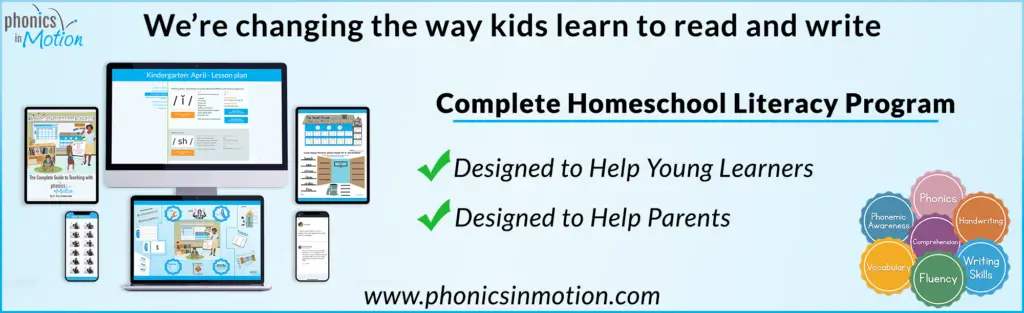
For an added literacy bonus, you can incorporate motion and stories throughout your day for more explicit teaching. For example, Phonics in Motion’s kinesthetic motions for the phonemes (KMPs) gives kids a high-energy motion for each phoneme. They can use them throughout the day, reinforcing phonemic awareness and phonics skills in every interaction.
How Phonics in Motion Helps Teach Literacy At Home
Phonics in Motion offers a comprehensive literacy instructional method and program. The multisensory, engaging routines and activities connect each pillar of literacy through the power story and motion! Kids learn reading and writing through fun, whole body learning experiences that speed up the literacy process! Backed by the Science of Reading, families are supported with the tools to bring literacy into everyday moments. The program supports preschool years through third grade and beyond.
I hope this helps give you some ideas on how you can teach literacy skills effectively in your homeschool! And I’d love to hear from you: are there any tips you can share with other homeschool moms that have worked the best for you? Drop a comment below!

Related Posts
- Why Visual Perceptual Skills are Important for Your Kids
- How to Write a Book Report (+ a FREE Step-by-Step Printable for Your Kids)
- 15 Ways to Help Your Kids Learn Sight Words
Blessed Homeschool is a participant in the Amazon Services LLC Associates Program, an affiliate advertising program designed to provide a means for sites to earn advertising fees by advertising and linking to Amazon.com. You can read my full affiliate disclosure HERE.