

10 Tips for Planning Your Homeschool Year
Just so you know, this post contains affiliate links. That means if you use them to make a purchase, I may earn a commission. You can read my full affiliate disclosure HERE.
Planning your homeschool year can feel exciting…and overwhelming. With so many curriculum choices, scheduling options, and responsibilities to juggle, it’s easy to start strong and then burn out by October.
But what if planning your homeschool year didn’t have to feel so stressful?

Tips for Planning Your Homeschool Year
Whether you’re brand new to homeschooling or a seasoned pro looking for a simpler approach, these 10 tips will help you plan a homeschool year that’s not only doable—but peaceful and productive, too.
1. Start with Your Why
Before you choose a single book or write out a schedule, take time to remember why you homeschool.
- Is it to nurture your kids’ faith?
- To allow flexibility for your family’s needs?
- To give your children a personalized education?
Writing down your “why” will guide your decisions—and encourage you when things get tough.
⭐Example: A Homeschool Mom’s “Why”
Maybe your homeschool mission statement could look something like this:
“We homeschool because we want to disciple our children in their faith, strengthen our family relationships, and provide an education that allows each child to learn at their own pace while developing a lifelong love of learning.”
When curriculum decisions come up, this “why” becomes a filter. For example…if a curriculum looks impressive but requires hours of busywork that leaves your family stressed and exhausted, you might decide it’s not the best fit. If your schedule becomes overloaded with activities, your “why” can remind you that family relationships and discipleship matter more than filling every hour of the day.
There will be moments during the year when lessons don’t go as planned, a child struggles with a subject, or life throws unexpected challenges your way. Having your “why” written down gives you something to return to. It helps you remember the bigger picture and make decisions with confidence instead of reacting out of frustration or comparison.
2. Set Realistic Goals
What do you want your kids to accomplish this year—spiritually, academically, and personally?
Keep goals simple and specific, like “learn multiplication facts,” “read independently,” or “study one artist per term.” Avoid packing in too much. A few focused goals go a long way!
⭐Example: Setting Realistic Goals
Instead of creating a long list of things you hope to accomplish, try choosing just a few priorities for each child.
For example, a parent with a third grader might set goals like:
- Read chapter books independently for 20 minutes each day
- Master multiplication facts through the 12s
- Memorize one Bible verse each month
- Develop the habit of completing daily work without constant reminders
Notice that these goals are specific and measurable, but they aren’t overwhelming. They focus on meaningful progress rather than trying to cover everything at once.
A parent with a high school student might choose goals such as:
- Complete Algebra 1 with a solid understanding of the concepts
- Read six quality literature books during the year
- Improve essay-writing skills through regular writing assignments
- Serve consistently in a church or community ministry
When planning your year, remember that not every good opportunity needs to become a goal! It’s better to make significant progress in a few important areas than to spread yourself so thin that nothing gets the attention it deserves. As the year unfolds, these goals can help you stay focused on what matters most and make decisions about where to spend your time and energy.
3. Choose Curriculum That Fits Your Season
Not every wonderful curriculum is right for your family this year.
Consider:
- How many kids you’re teaching
- How independent your kids can be
- How much time you have to prep and teach
Don’t be afraid to choose something open-and-go or online-based if it makes life easier in this season.
⭐Pro Tip
Before finalizing your curriculum choices, try mapping everything out for the year. Seeing all of your subjects, activities, and commitments together can help you identify potential overload before the school year begins.
This is one of my favorite uses for the Homeschool Curriculum Planner, but even a simple spreadsheet or notebook can help you get a realistic picture of what your year will look like.
4. Don’t Overschedule
You don’t need to do every subject every day. Many homeschool families rotate subjects throughout the week.
For example:
- Science on Mondays and Wednesdays
- History on Tuesdays and Thursdays
- Fun Friday for art, music, or nature study
A balanced weekly routine can help avoid burnout and still get it all done!
5. Block Time for Group Work
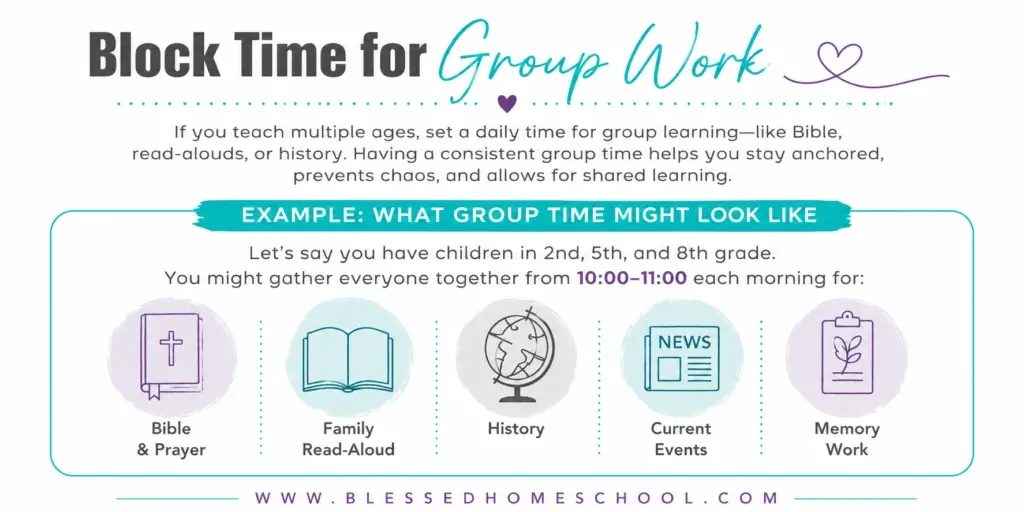
If you teach multiple ages, set a daily time for group learning—like Bible, read-alouds, or history.
Having a consistent group time helps you stay anchored, prevents chaos, and allows for shared learning (which is one of the joys of homeschooling!).
⭐Example: What Group Time Might Look Like
Let’s say you have children in 2nd, 5th, and 8th grade. Instead of teaching every subject separately, you might gather everyone together from 10:00-11:00 each morning for:
- Bible and prayer
- A family read-aloud
- History
- Current events
- Memory work
Then, after group time ends, each child moves into their individual subjects like math, language arts, or grade-specific science.
This approach allows you to teach several subjects at once while creating shared experiences that your children will remember. Some of our favorite homeschool memories have come from books we’ve read together, discussions we’ve had during history lessons, and conversations sparked during our family Bible time 💜.
The exact subjects don’t matter as much as creating a consistent rhythm. When everyone knows, “This is our family learning time,” it becomes an anchor point in your day and helps the rest of your schedule flow more smoothly.
6. Build in Margin
Life happens.
Kids get sick, appliances break, or you just need a slow day. When you build in extra days on your calendar or leave afternoons flexible, you can stay on track without the stress of “falling behind.”
⭐Example: Building Margin into Your Homeschool Year
One of my favorite planning strategies is to map out the entire school year before we begin. I block off holidays, planned vacations, co-op breaks, and other commitments first. Then I schedule our curriculum around those dates rather than hoping everything will fit later.
The goal isn’t to fill every square on the calendar. It’s to create a realistic plan that accounts for real life. I always like to leave “extra” days in our school year that are unscheduled, so I have a little bit of peace of mind. When margin is built into your schedule from the beginning, unexpected interruptions become minor adjustments instead of major sources of stress.
7. Include Fun and Enrichment
Homeschooling isn’t just about checking off boxes.
Make room for things that bring joy—like field trips, poetry tea time, nature walks, game school, or art projects. These extras often become the most meaningful part of your homeschool memories.
8. Create a Simple Routine
You don’t need a color-coded hourly schedule (unless you love that!).
A simple daily rhythm—like Morning Time, Independent Work, Lunch, then Hands-on Learning—can give your days structure without being rigid. Find what works for your family’s flow.
⭐Pro Tip
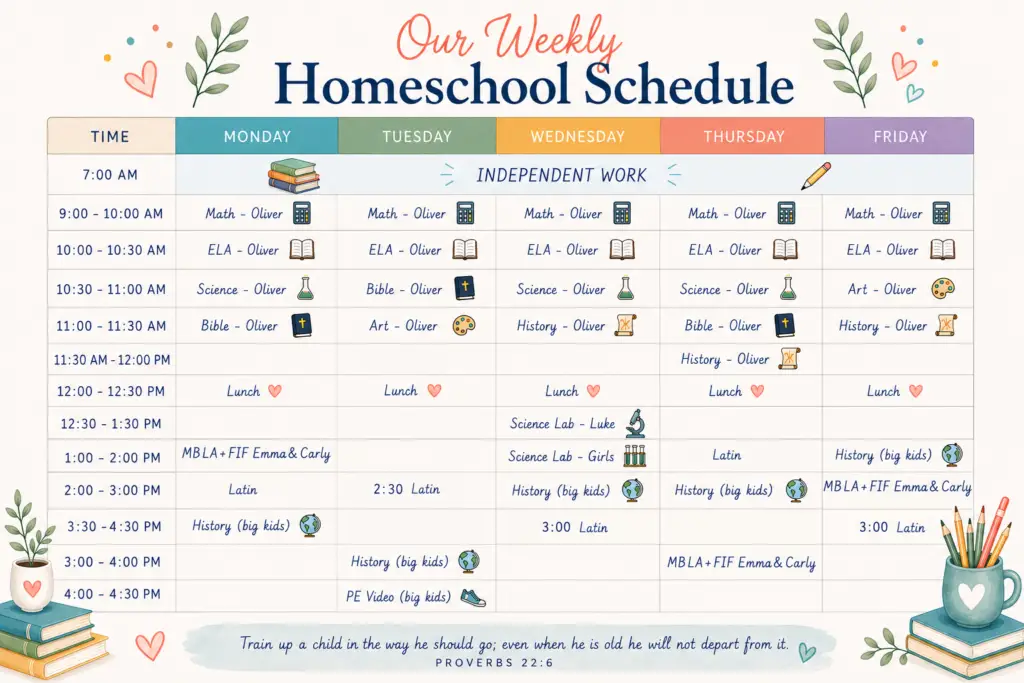
Plug your routine ideas into Chat GPT for a nice visual image of your routine you can hang in your homeschool area! Here’s ours THIS year with a 9th grader, twin 8th graders and a 2nd grader (warning: it’s not necessarily simple, but this is how we roll & fit it all in):
9. Prepare Your Materials in Advance
Take time before the year starts to:
- Print worksheets or notebooking pages
- Organize books and supplies
- Add lessons to your planner (or use a tool like Homeschool Curriculum Planner)
You don’t have to plan every single day—but having the first few weeks ready helps you start strong.
10. Be Flexible and Give Yourself Grace
Even the best homeschool plans will need adjusting.
Some weeks you’ll soar, and other weeks you’ll just get the basics done—and that’s okay. Your homeschool doesn’t have to be perfect to be powerful. God called you to this, and He’ll equip you for it!

Final Thoughts on Planning Your Homeschool Year
Planning your homeschool year doesn’t have to be overwhelming. With a little intention and a whole lot of grace, you can create a plan that works for your family—one that leaves space for both structure and flexibility.
Remember, homeschooling is a journey! Don’t strive for perfection—aim for faithfulness. And take it one day, one lesson, one heart connection at a time.

Related Posts
- 7 Must-Have Tools for Homeschool Organization
- How I’m Planning Our Homeschool Schedule This Year
- The Ultimate Homeschool Planning Checklist
Blessed Homeschool is a participant in the Amazon Services LLC Associates Program, an affiliate advertising program designed to provide a means for sites to earn advertising fees by advertising and linking to Amazon.com. You can read my full affiliate disclosure HERE.
