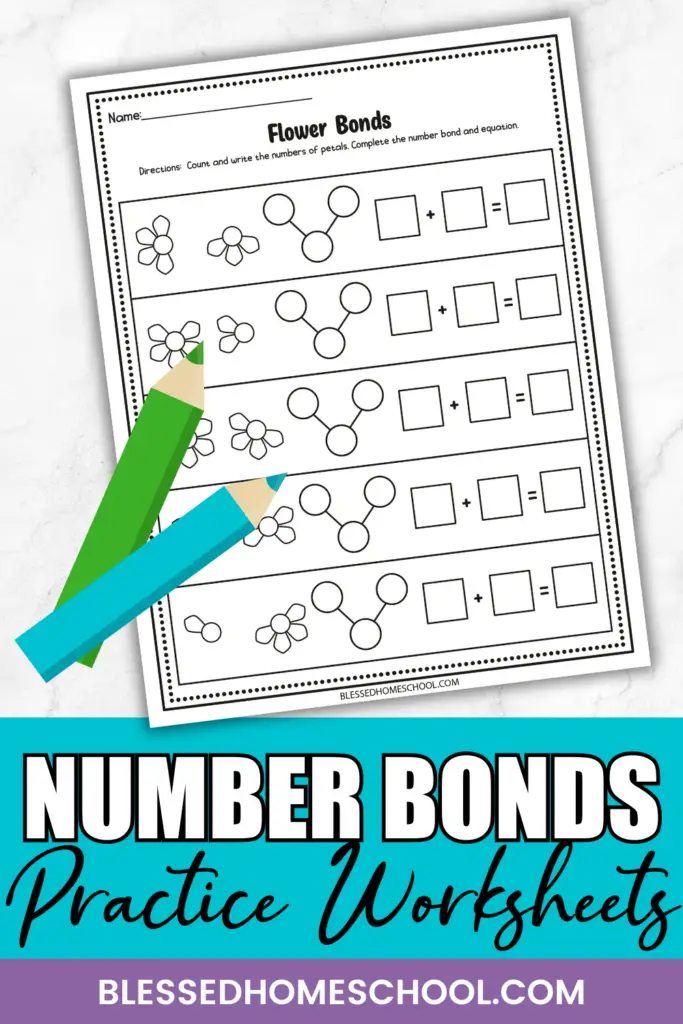
FREE Number Bonds to 10 Worksheets for Teaching Math
Just so you know, this post contains affiliate links. That means if you use them to make a purchase, I may earn a commission. You can read my full affiliate disclosure HERE.
As a former math teacher, you might think that teaching my kids math has always come super easy for me.
Honestly, my oldest is just now getting into Algebra, and I can finally say THIS is my happy place.
Elementary level math? Not so much!
I remember the first printable resource I ever sought out online was something to help us practice number bonds, because it was one of those things we just needed a lot of practice with. And from seeing the other end of things, I knew I wanted to try to ensure my kids had strong number sense from the get-go.
And if you’re a homeschooling parent or educator looking for effective ways to build foundational math skills in your own young learners, I hope this post will be helpful to you! We’ll explore what number bonds are, why they’re crucial in developing number sense, the age group that typically learns them, and how you can teach them effectively at home.
Plus, I’ve got some FREE Number Bonds worksheets to share with you to make learning fun and engaging.
What Are Number Bonds?
Number bonds are pairs of numbers that, when added together, form a given number. For instance, the number bonds to 10 include pairs like 1 and 9, 2 and 8, 3 and 7, and so on.
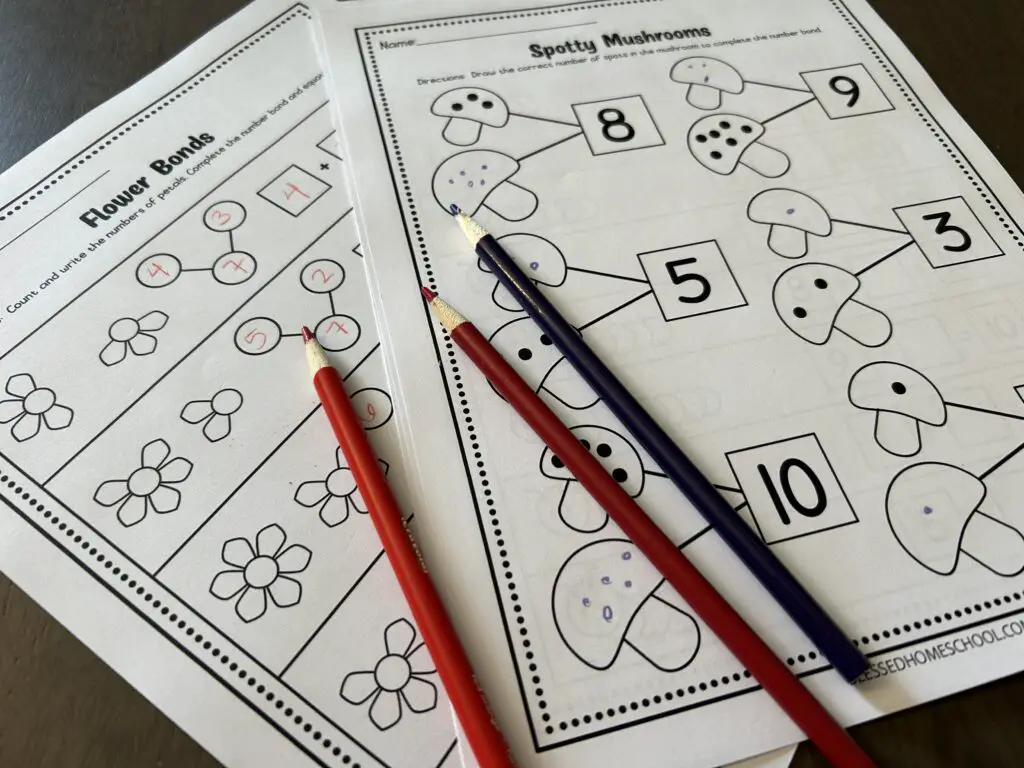
Visual aids often represent number bonds using circles connected by lines, where each circle contains a number that combines with another to make 10. These simple yet powerful tools help children visualize and understand the relationships between numbers.

Importance of Learning Number Bonds
Understanding the concept of number bonds is essential for building a strong foundation in mathematics, because they really help children grasp the concept of addition and subtraction more intuitively.
For example, knowing that 3 + 7 = 10 helps children quickly figure out related subtraction facts (like 10 – 7 = 3), demonstrating the inverse relationship between addition and subtraction. This fluency is critical as it prepares students for more complex mathematical operations like multiplication and division.
Number bonds also enhance mental math skills, enabling children to solve math problems more efficiently. For example, take the problem 297 + 9. This is a simple example, but knowing that 3 and 6 make 9 allows kids to easily think about this problem as 300 + 6 instead.
Age Group for Learning Number Bonds
Typically, children start learning about number bonds in kindergarten through early elementary school, around ages 4 to 7. This includes 1st grade, where first grade math worksheets often introduce number bonds as part of the national curriculum or common core standards.
At this developmental stage, kids are ready to grasp basic addition and subtraction concepts. Introducing number bonds at this age helps solidify their understanding of how numbers work together, laying the groundwork for future math success.
Teaching Number Bonds at Home
Teaching number bonds at home can be both effective and enjoyable with the right math teaching strategies.
Use Visual Aids and Manipulatives: Utilize a tens frame, counters, blocks, or beads to visually represent number bonds. This hands-on approach makes abstract concepts concrete and reinforces place value and whole number understanding.
Incorporate Games and Activities: Engage kids with math games, matching games, flashcards, or interactive online games that reinforce number bond concepts. This is a fun way to make learning engaging.
Step-by-Step Approach: Start with concrete examples before moving to abstract representations. For instance, use physical objects like apples or toys to demonstrate how different combinations add up to 10.
Real-Life Scenarios: Apply number bonds to everyday situations, such as sharing snacks or grouping toys, to make learning relevant and practical.
Free Number Bonds to 10 Worksheet
My free Number Bonds to 10 printable includes 8 pages of simple activities for your kids to complete!
Worksheets provide a systematic way for children to practice number bonds, reinforcing their skills through repetition, and will also help you assess your child’s understanding of the topic before moving on.

Click here to grab this printable today to use in your homeschool!

Learning number bonds to 10 is a crucial step in developing strong number sense and mathematical fluency in young children. By incorporating number bond activities and worksheets into your homeschooling routine, you can help your child build a solid foundation for future math success.
Remember to keep learning fun, encourage regular practice, and celebrate progress along the way. Happy teaching!

Related Posts
- Number of the Day FREE Math Worksheets for Elementary
- CTCMath Online Math Curriculum Review: What You Need to Know
- Benefits of the Singapore Math Method for Homeschoolers
Blessed Homeschool is a participant in the Amazon Services LLC Associates Program, an affiliate advertising program designed to provide a means for sites to earn advertising fees by advertising and linking to Amazon.com. You can read my full affiliate disclosure HERE.