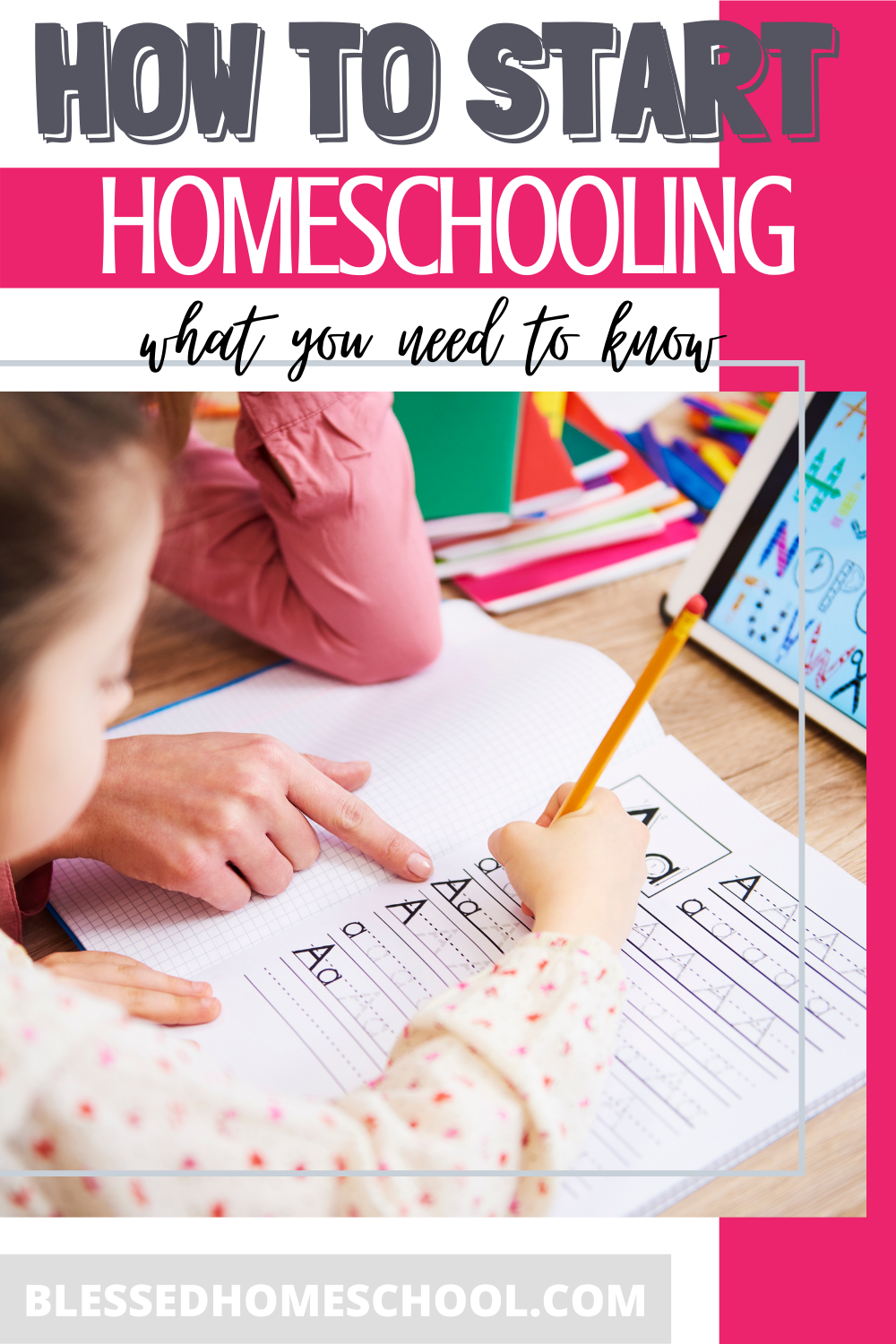
How to Start Homeschooling: What You Need to Know
Just so you know, this post contains affiliate links. That means if you use them to make a purchase, I may earn a commission. You can read my full affiliate disclosure HERE.
Have you been feeling a tug to bring your kids home for school—but don’t know where to start? Maybe you’ve seen the benefits of homeschooling and are ready to make the leap, but you’re also wondering… Am I really qualified for this? How do I even begin? Will my family think I’ve lost my mind?
Take a deep breath, friend. You’re not alone—and yes, you can do this.
I remember exactly how overwhelming those first thoughts of homeschooling felt. There’s so much information out there, and it’s easy to get stuck in research mode. But the truth is, homeschooling doesn’t have to be complicated. In fact, with the right support and a step-by-step plan, you can start homeschooling with confidence.
This guide will walk you through the essential steps to start homeschooling—from understanding your state laws to choosing curriculum and finding your groove at home. Whether you’re pulling your child out of public school or starting fresh, you’ll find helpful, realistic advice to guide you through the early days.
Ready to begin? Let’s walk through the first steps of your homeschool journey together.
✅ Step 1: Understand Your State’s Homeschool Laws
Before you dive into lesson plans or curriculum choices, it’s essential to understand the legal requirements for homeschooling in your state. Every U.S. state has different laws when it comes to home education, and following them ensures that your homeschool is compliant from the very beginning.
Start by visiting the HSLDA (Home School Legal Defense Association) website. They offer an easy-to-understand breakdown of homeschool laws by state. You can also check your state’s Department of Education website for official regulations.
Here are some key things to look for:
- How to legally withdraw your child from public school
- Whether you need to submit a notice of intent
- Testing or assessment requirements
- Attendance or record-keeping rules
- Subjects you’re required to teach
- Compulsory attendance age (the age range during which education is legally required)
- Immunization or health-related regulations
- Who can homeschool (some states require the parent to have a high school diploma or GED)
Some states are very relaxed, while others require more oversight—so it’s important to know exactly what’s expected where you live. Keeping a simple binder or digital folder for all legal documentation (like notices, test results, or attendance records) can help you stay organized and stress-free throughout the year.
And if you want to explore what homeschooling looks like across the country, check out my Homeschooling in 50 States series—filled with advice from homeschooling families and bloggers in each state.
Once you know the law, you can move forward with confidence knowing your homeschool is on solid legal ground.
✅ Step 2: Officially Withdraw Your Child from School (If Needed)
If your child is currently enrolled in a public or private school, you’ll need to formally withdraw them before beginning your homeschool journey. The process varies by state, so be sure to check your specific state’s homeschool laws (see Step 1) to know exactly what’s required.
In most cases, you’ll need to submit a notice of intent to homeschool to your local school district or state education office. This is often a simple letter that states your plan to homeschool, lists your child’s name and grade, and affirms that you’ll be providing instruction in required subjects.
Here are a few tips to make the process smooth:
- Submit your withdrawal notice in writing—even if your state allows email or online submissions, a hard copy is a good idea for your records.
- Request confirmation of receipt, especially if you’re mailing your letter.
- Keep copies of all communications for your homeschool records binder.
Some states have specific forms you’ll need to use, while others allow you to write your own. If you’re not sure what your state requires, HSLDA and your state homeschool organization are great resources for templates and guidance.
Once your child is officially withdrawn, celebrate! This is the first official step into your new homeschooling life—and it’s worth marking with a little joy (maybe a special breakfast or a homeschool kickoff day!).
✅ Step 3: Connect with Local Homeschool Groups and Support Networks
Homeschooling doesn’t mean you have to go it alone. In fact, one of the best things you can do as a new homeschooler is find your people—other homeschool families who can encourage, support, and walk alongside you on this journey.
Joining a local homeschool group offers so many benefits:
- Friendship and support for both you and your kids
- Group field trips, co-ops, enrichment classes, and park days
- Used curriculum sales to help you save money
- Advice from experienced homeschool moms who’ve been where you are
- Opportunities for socialization and shared learning experiences
You can find local homeschool groups through:
- Facebook (search “[Your City] Homeschool Group”)
- Libraries, churches, or community centers
- Homeschool directories like Homeschool Hall, which helps you find groups and resources near you
Some areas have formal co-ops that meet weekly and follow a structured schedule, while others are more casual and focused on playdates and connection. Try a few different groups to see what fits your family best.
Connecting with other homeschoolers will make your first year feel a lot less lonely—and you’ll learn so much just by hearing others share what works (and what doesn’t).
✅ Step 4: Give Yourself and Your Child Time to Deschool
Once you’ve officially withdrawn from school, your instinct might be to dive straight into a full homeschool schedule—but don’t skip this important step: deschooling.
Deschooling is the intentional break you take after leaving a traditional school setting. It’s time to rest, reset, and reimagine what learning can look like at home—for both you and your child.
Here’s why it matters:
- Your child may need time to decompress, especially if their previous school experience was stressful or negative.
- Even if school was a good fit, they still need time to adjust to learning in a completely different environment.
- You may need time to let go of the idea that learning must look like desks, worksheets, and bells to be effective. Homeschooling is a whole different mindset.
A good rule of thumb is to deschool for about one week for every year your child spent in traditional school—but feel free to adjust that based on your family’s needs.
During deschooling, focus on relationship-building and curiosity-led learning:
- Read books together
- Visit museums or nature trails
- Watch educational documentaries
- Do simple art projects
- Cook, garden, or build something together
This is a great time to observe how your child learns best and start thinking about your homeschool style and rhythm (we’ll get to that in the next step!).
Deschooling isn’t wasted time—it’s the foundation for a joyful homeschool experience. By easing into this new chapter, you’ll build confidence, connection, and clarity about how to move forward.
✅ Step 5: Learn About Different Homeschooling Methods
One of the most freeing (and sometimes overwhelming) things about homeschooling is that there’s no one-size-fits-all method. You get to choose how your family learns—and that choice can make a big difference in your homeschool experience.
As you’re deschooling and easing into homeschooling, take some time to explore the different homeschooling styles or philosophies. These are approaches to education that shape how you structure your day, choose curriculum, and teach your children.

Here are a few popular homeschool methods to look into:
- Charlotte Mason – A gentle, literature-rich approach focused on short lessons, nature study, and forming good habits.
- Classical – Rooted in the stages of learning (grammar, logic, and rhetoric), with a strong emphasis on language, logic, and great books.
- Montessori – Encourages independence, hands-on learning, and following the child’s interests at their own pace.
- Unschooling – Child-led learning based on curiosity, interests, and real-life experiences rather than a set curriculum.
- School-at-Home – Closely mirrors traditional school, often using textbooks or online programs with structured schedules.
- Unit Studies – Teaches multiple subjects around one central theme or topic (great for teaching multiple ages together!).
- Eclectic – A customized mix of various styles and resources, based on what works best for your family.
Most homeschoolers end up becoming eclectic over time—pulling from different methods and making it their own.
You don’t need to commit to one method right away, but understanding the options will help you make better curriculum choices and feel more confident in your homeschool identity. If you’d like help figuring out your style, try a homeschool method quiz or browse examples of daily routines from each approach.
✅ Step 6: Understand Your Child’s Learning Style
Now that you’re exploring homeschool methods, it’s also helpful to think about how your child learns best. Understanding your child’s learning style can make your homeschool day smoother and more enjoyable—for both of you!
While research on learning styles is mixed, many homeschool parents find that paying attention to how their child naturally engages with new information helps shape more effective lessons.
Here are the three most common learning styles:
- Visual Learners
These kids learn best by seeing. They enjoy diagrams, illustrations, maps, color-coded notes, and videos. Visual learners often benefit from writing things down and love using planners or checklists. - Auditory Learners
These learners thrive when they can hear information. They may do well with read-alouds, discussions, music, audiobooks, or repeating things out loud to themselves. - Kinesthetic Learners
These are the hands-on, move while they learn kids. They remember things better when they act them out, build, experiment, or move their bodies while studying. Sitting still for long periods is usually tough for them.
Your child may lean strongly toward one style or show a combination of several. The beauty of homeschooling is that you can observe their preferences and adapt accordingly. You might let your visual learner use a whiteboard to sketch out ideas, let your auditory learner recite spelling words aloud, or let your kinesthetic learner act out a history lesson or do math while bouncing on a yoga ball.
And don’t worry—you don’t have to tailor everything perfectly to their learning style. Just being aware of it can help you choose curriculum that fits and present lessons in ways that keep your child engaged.
The good news is, many homeschool programs today are designed to be multisensory—incorporating visuals, audio, and hands-on activities all in one.
✅ Step 7: Follow Homeschool Educators and Creators for Daily Inspiration
One of the best ways to stay encouraged and keep growing as a homeschool parent is to learn from others who’ve gone before you. Thanks to the internet, you don’t have to homeschool in isolation—you can connect with experienced homeschoolers, see real-life routines, and get fresh ideas every day.
Start by following homeschool moms, educators, and creators on platforms like:
- YouTube – Find curriculum flip-throughs, day-in-the-life vlogs, and helpful tutorials.
- Instagram – Get daily snapshots of homeschool life, tips, and encouragement.
- Podcasts & Blogs – Perfect for deeper dives into topics like homeschool methods, parenting, and organizing your day.
- Facebook Groups – Join communities where you can ask questions, share wins, and get support.
As you scroll, remember: no two homeschools look the same. Use what you see online for inspiration—not comparison.
Look for voices that:
- Align with your family’s values
- Teach from experience (especially if they’ve homeschooled for a few years)
- Encourage grace, not perfection
- Offer practical advice for your child’s age range
You’re also welcome to explore my other posts and homeschool videos—I regularly share curriculum reviews, homeschool tips, and behind-the-scenes peeks into our homeschool life.
And if you’re ready to dive deeper, check out my list of must-read books for homeschool moms. These resources can equip you with wisdom and encouragement as you settle into your new role.
✅ Step 8: Choose Your Homeschool Curriculum
Once you’ve explored homeschool methods and learning styles, it’s time to choose your curriculum—but don’t panic! You don’t have to get it perfect the first time.
In fact, here’s a little homeschool secret: most families try a few different curricula before finding what truly works. And what works for one child may not work for another—and that’s okay.
Start by prioritizing the essentials:
- Reading/Language Arts
- Math
These two subjects are foundational and often need to be tailored to each child’s level, especially if you’re homeschooling multiple kids.
Then think about what kind of curriculum works best for you and your kids. Ask yourself:
- Do I want a structured, open-and-go plan or something more flexible?
- Would I prefer online homeschool curriculum, printed workbooks, or literature-based learning?
- Do I want video instruction or plan to teach everything myself?
- How much time can I realistically spend on lessons each day?
Here are a few helpful tips:
- Try before you buy. Many companies offer free samples, placement tests, or trial lessons.
- Ask around. Local groups and online communities can give honest reviews.
- Don’t feel pressure to choose everything at once. You can add subjects like history, science, or art later.
- Resist the urge to copy someone else’s exact plan. Use recommendations as inspiration, but make choices that match your own family’s needs.
If you’re feeling stuck, check out my free homeschool curriculum planner. It includes space to map out what you’re considering, compare options, and even see recommendations based on different homeschool styles.

And if you have the chance, I highly recommend attending a homeschool convention (like Teach Them Diligently). Walking through the exhibit hall, talking to curriculum providers, and hearing sessions from experienced homeschoolers can be incredibly inspiring—and clarifying.
Take your time and give yourself permission to adjust as you go. You don’t need a perfect plan—you just need a place to begin.
✅ Step 9: Start Your Homeschool Routine Slowly and Simply
You’ve done the research, chosen your curriculum, and now it’s time to start homeschooling! But before you dive in with a full schedule and high expectations, let me encourage you with this: start small.
It’s tempting to recreate a full school day at home—math, reading, history, science, spelling, handwriting, Bible, art, music, P.E.… all by 3:00 p.m. But trying to do it all from day one is a fast track to burnout—for both you and your kids.
Instead, ease in gradually. Start with just one or two core subjects (like math and reading), and once those feel comfortable, add in another subject every few days or each week. This gentle start helps you:
- Build confidence as a teacher
- Learn your child’s natural rhythm and pace
- Figure out what works (and what doesn’t)
- Keep the atmosphere calm and joyful
You can also begin with something fun! Art projects, science experiments, read-alouds, or nature walks are great ways to spark curiosity and remind your child that learning can be exciting and meaningful.
Here’s a sample “soft start” schedule:
- Week 1: Focus on reading aloud and one subject (like math)
- Week 2: Add language arts or science
- Week 3+: Gradually introduce other subjects or special projects
Don’t worry if your day doesn’t look like someone else’s. Homeschooling is flexible by design—you can learn in the morning, the afternoon, in short bursts, or long stretches. Some families do “morning baskets,” loop schedules, or four-day weeks. You’ll find your flow over time.
And remember: the goal isn’t to replicate the classroom. The goal is to create a home where learning happens in a way that works for your family.
📋 Frequently Asked Questions About Starting Homeschooling
Is homeschooling legal in all 50 states?
Yes! Homeschooling is legal in all 50 U.S. states. However, the laws and requirements vary by state. Be sure to check your local regulations (see Step 1 above) to understand what’s required where you live.
Can I homeschool if I work full-time?
Yes, it’s possible to homeschool while working full-time, though it takes extra planning and flexibility. Many families homeschool in the evenings, on weekends, or use a four-day week. Online or self-paced programs can also help make it manageable. The key is finding a rhythm that works for your family’s lifestyle.
How much does homeschooling cost?
Homeschooling can be affordable or expensive—it really depends on your choices. You can homeschool on a tight budget using free or low-cost resources, or invest in premium curriculum and co-op classes. Most families spend anywhere from a few hundred to a couple thousand dollars per year, per child.
Do homeschoolers get a diploma?
Yes! As a homeschool parent, you can issue your child a high school diploma when they’ve completed the coursework you’ve set. Many homeschoolers also create a transcript, which is accepted by colleges, trade schools, and employers. There are even templates and services to help you create both.
How do I socialize my homeschooled kids?
Socialization often happens naturally through homeschool groups, co-ops, church, sports teams, extracurriculars, field trips, and community events. In fact, many homeschoolers build strong relationships with people of all ages—not just same-age peers.
Can I start homeschooling in the middle of the school year?
Absolutely. You can start homeschooling at any point during the year. Just be sure to follow your state’s withdrawal and notification procedures. Taking a few weeks to deschool can help make the transition smoother for your child.
Final Encouragement: You Were Made for This!
Starting homeschooling can feel overwhelming—there’s a lot to learn, a lot to plan, and a lot of voices telling you how it “should” be done. But here’s the truth: you don’t have to have it all figured out to get started.
You love your children. You’re willing to learn. You’re seeking wisdom and support. That’s exactly what qualifies you to homeschool.
Homeschooling isn’t about having a Pinterest-perfect setup or checking every box. It’s about nurturing your child’s heart and mind, day by day, with grace and patience. It’s about growing together as a family and discovering the joy of learning as a lifestyle—not just something that happens in a textbook.
So take it one step at a time:

- Know your laws
- Make your withdrawal official
- Find your support system
- Give yourself time to ease in
- And trust that it’s okay to learn as you go
You were created for this—and you don’t have to do it alone. I’m cheering you on every step of the way!
If you know another parent who’s just starting their homeschool journey, please share this post with them or pin it for later.
💡 And don’t forget to check out my Homeschool Freebies Page and grab your copy of the Free Homeschool Curriculum Planner to help you organize your thoughts and next steps.


Related Posts
- Effortlessly Create and Organize a Homeschool Portfolio
- Practical Homeschool Organization Tips + FREE 30 Day Challenge Printable
- The Best Chore Charts for Kids (You’ll LOVE this System!)
Blessed Homeschool is a participant in the Amazon Services LLC Associates Program, an affiliate advertising program designed to provide a means for sites to earn advertising fees by advertising and linking to Amazon.com. You can read my full affiliate disclosure HERE.